
Article: ANJALI MEHTA
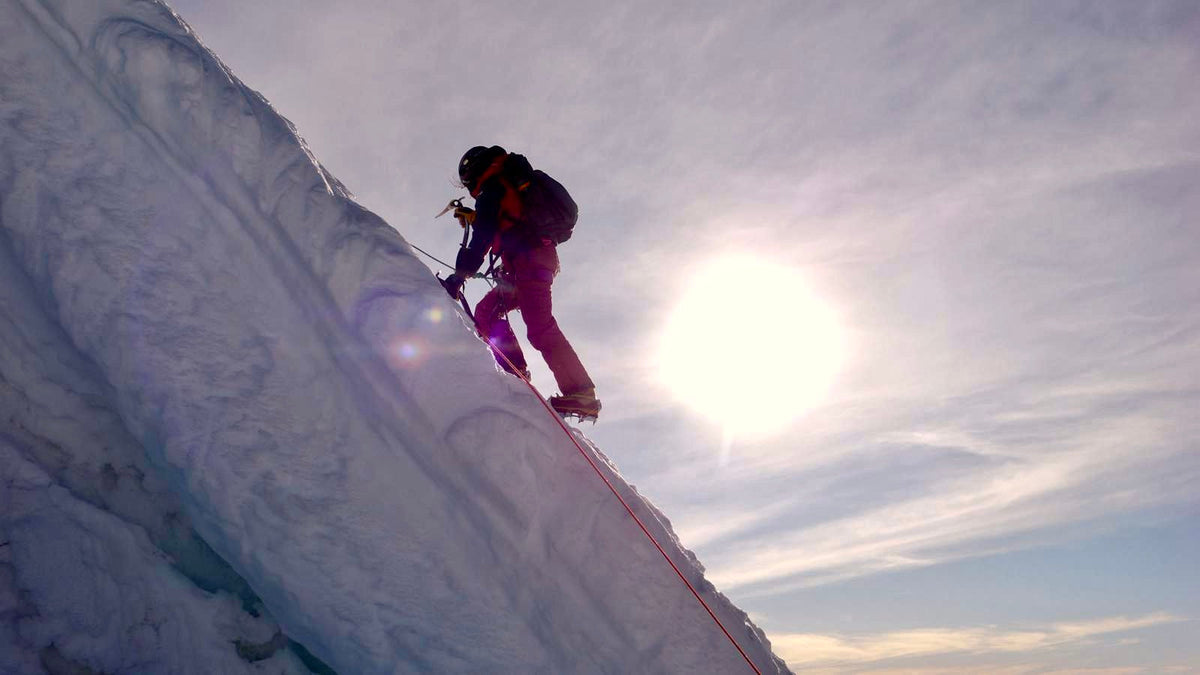
ANJALI MEHTA
'Climbing forced me to be so present that I realised I hadn't actually been present in my body before. I'd just been using movement, using dance, as a way to escape.'

Anjali Mehta is an international human rights lawyer, storyteller, social entrepreneur, and athlete. A survivor of sexual trauma, she found her way back to her body through mountaineering, and has since co-founded the non-profit What is the Power of We?, which combats gender-based violence through her Survivors to Summits campaign. Through this initiative, she is climbing the highest peak on every continent to raise awareness and funds for organisations supporting survivors. Trained from childhood in Bharatanatyam, a classical Indian dance form rooted in storytelling, Anjali weaves together law, movement, and advocacy into a single, continuous thread.
You've spoken about climbing as a way to reclaim ownership of your body. What did movement give you that words or intellectual work could not?
I'm a survivor of sexual trauma, and after experiencing that, I felt extremely disconnected from my body. I remember waking up and looking at myself in the mirror and not recognising myself from a physical perspective, which, as a performer and an athlete, is an incredibly jarring experience. Not feeling at home in a body that has held so much for you is disorienting, and it took a long time of trying to perform again, trying to dance again, before I found a way to reclaim ownership over my body by actually being present in it.
About ten years after that first experience, I decided, almost on a whim, to climb a 6,900-metre mountain in Latin America. I thought I was in a normal place with my body by then, that I'd reconnected with it. But getting on that mountain was the first time movement forced me to be so present that it allowed me to step into a power I didn't even remember I had. That's when I realised I'd actually been using movement as a way to escape, not to be present, and that climbing was what finally got me there.

You wear so many hats: lawyer, artist, athlete, dancer, entrepreneur. Can you tell us a bit about your background?
It's funny, because all of these things are connected by one through-line. I like to say I'm a storyteller. Whether it's telling stories through the law, through performance or dance, or through climbing these mountains, that thread runs across everything I do. To me, storytelling is really the purpose of human connection. It's how we connect with one another, how we build community, how we engage with the world.
Everything I've done, whether in a courtroom, on a stage, or on a mountain, has come from that place of telling stories, including my own, in the most vulnerable and authentic way I can, and finding ways to tell stories that don't often make the front page.
Were you encouraged towards extreme physical challenges from a young age?
From an athletic perspective, both of my parents were very focused not just on fitness, but on what being an athlete teaches you as a person: resilience, discipline, commitment, pushing yourself physically. I grew up in dance and martial arts, and those became the two main foundations of how I trained. Alongside that were competition and cardio elements that complemented each other and gave me the foundation to know how to train myself, whether that was for climbing high mountains or continuing to dance. It's something that was instilled in me early on and has become second nature.
You've described movement as healing rather than escape. Can you go deeper into that distinction?
It's a tricky one, and honestly one I'm still trying to unravel myself. When I was dancing after the trauma, I was losing presence of mind. I wasn't really engaging with my breath or with what my body was doing; I was just moving for the sake of moving, letting my mind run wherever it needed to run. That felt more like escape. I don't think there's a value judgement on that, there's a place for that kind of movement too, but I came to realise I wasn't actually present in my body. So the reconnection was happening on a surface level, but not really, because my brain was somewhere else.
Climbing changed that, because my brain couldn't go anywhere else. If I stopped focusing on my foot placement for even a second, I would trip, step into a crevasse, or step on a rope and cause someone to fall. There are very tangible consequences to letting your mind wander on a mountain. That forced me to understand that this kind of presence, connecting my breath to my step to the environment around me, wasn't something I'd actually been practising through dance before. That presence is what took me to the next stage of healing, rather than just compartmentalising emotions and putting them aside through movement.

Do you think there's a part of you that's drawn to extreme challenges, that needs adrenaline to feel alive?
I was actually talking to my therapist about this exact thing last week, and I think the answer is yes. When you experience heightened emotions like fear or danger, you learn a lot about yourself, about how you react when you need to make a decision quickly to stay safe. That's always fascinated me, because those are the moments where I feel I'm really able to grow and understand who I am.
A lot of the time, we walk around with a veil between who we are and how we interact with the world. But in situations of extreme danger and fear, you don't have time to pretend to be anyone. You don't have time to think about how someone will perceive you. You need to act, and you need to be present, or you put yourself at real physical risk. You have to confront who you are in those moments. I'm constantly chasing that understanding of myself, and the ways I get there have kept becoming more extreme, especially as I go to higher altitudes. But there's something very satisfying about actually confronting yourself like that.
What actually happens to the body at altitude, in the cold, under that kind of stress?
I was just on Denali in Alaska, so I'll use that as an example. At minus 40 degrees, which is the same temperature in both Fahrenheit and Celsius, if you take your gloves off and expose your bare hands to the air, you can get frostbite within two to three minutes. It's so cold you need to cover every part of your body to avoid losing limbs.
On top of that, as you go higher, oxygen levels drop rapidly. Denali is 6,190 metres, and at that altitude you're operating on roughly half the oxygen you'd have at sea level. That affects your muscles, but it also affects your brain, so you're making high-stakes decisions in a state where you genuinely can't fully trust your own judgement. You're fully covered head to toe, possibly in a snowstorm, just taking one foot in front of the other. Any mistake, physical or mental, can be the difference between life and death. That's part of why I think any elite athletic endeavour, including climbing, is really a team endeavour. You have to lean into your coaches, your guides, your rope mates, because that reliance is often the difference between serious injury and elite performance.

Do you ever feel alone up there?
There have definitely been moments. On Denali specifically, we had five climbers and three guides, but our guides were quite hard on us. They used fear as a tactic to discourage us from continuing, and we ended up fighting their egos for most of the climb. You hope to have a strong group around you mentally, physically, empathetically, but sometimes the people you're climbing with are battling their own egos and aren't showing up as teammates in the way you'd hoped. Those were the moments I felt most alone, thinking, I hoped we could help each other get up this mountain safely, but the reality is we don't always.
In those moments, there's nothing to do except set those emotions aside and ask, how do I still find some level of success here, even while feeling that loneliness? It's an interesting balance: how much do you compartmentalise, how much do you let yourself feel it, and how do you take the next step forward anyway?
How has your experience been dealing with other people's egos in these high-stakes scenarios? Is that something you tend to observe more in men or women?
Mountaineering has actually taught me that ego isn't gendered, I've met women with incredible egos too. Where I've landed on this is that, especially in performance spaces, people are craving a sense of belonging, and when ego shows up, it's often someone's way of convincing themselves they belong in that space. Sometimes it tips into I belong here more than you do, and it becomes comparative. There's a fine line between confidence, I belong here, and ego, I deserve to be here more than others, and I don't think we talk about that line enough, particularly with boys as they grow up.

Let's talk about fear directly. When you feel that moment of fear, what do you do first?
Breath is physiologically the most important way we regulate our reaction to fear. But I also think it's important to just recognise that fear is an emotion everyone experiences, whatever form it takes for you. Naming it, this is fear, and not something else, is the first step.
I vividly remember my first real experience of extreme fear on a mountain. We were climbing up when another group came down, and their guide looked distraught. He told us one of his clients had had a heart attack on the summit and died; they'd tried CPR, but there had been no warning signs at all. Hearing that sent my heart rate skyrocketing. I could feel the blood pounding through my whole body. What helped was refocusing on the actual physical sensations rather than the fear itself: instead of 'I'm terrified', it became 'my heart rate has spiked', 'my hands are sweating'. Those are solvable problems. From there, I could use my breath, a deep inhale and a really long exhale, to slow my heart rate and keep going. Separating the sensation from the emotional spiral made it much more manageable.
You've mentioned that in elite performance you're never really alone, there's always a team. That seems connected to What is the Power of We? Can you explain what it is?
It was a long time coming. We've talked about my experience with sexual assault and the ongoing journey of understanding and integrating that. On that very first mountain I climbed, almost on a whim, I witnessed a guide hit a woman with his ice axe at a high camp, 5,000 metres up. There was this blood-curdling scream, and it all connected for me in that moment: even on a mountain, where you think you're away from society and just experiencing nature, the reality is we're all still human, and the things that happen in society happen in the mountains too.
That was the moment I realised this wasn't just my experience, it's something one in three women worldwide have experienced, and now one in two in the United States. It became an urgent call to re-understand my relationship to advocacy, both as a human rights lawyer and through my own story. Out of that came What is the Power of We? Our goal is first to raise awareness around gender-based violence and amplify survivors' voices and stories worldwide, and second, to raise money for organisations already doing the on-the-ground work. Long-term, we want to build a digital platform where those organisations can connect with each other to share resources and funding opportunities. It's really about connecting my personal experience as a survivor, the power of the mountains, and the connective role I've learned to lean into as a lawyer. I believe interdependence is how we accomplish things that feel too big to tackle alone.

After a huge achievement, like reaching a summit, how do you come back down emotionally?
It's such an important question. In the mountaineering community we actually talk about 'post-mountain blues'. There are a few layers to it: the adrenaline crash, the release of the physical safety concerns you'd put on hold the whole time you were out there, and then the harder question of how you integrate what you experienced back into daily life. It's a rolling process, you'll have highs when you think back on it, and real lows wondering if this is what normal life is supposed to feel like now.
I think it's important to talk about, because we often expect ourselves to get straight back into work, the gym, our families, right after these huge experiences, without giving ourselves time to actually process what happened. I'm still very much in that process myself, having got back from Denali about six weeks ago. What's worked for me is taking the first few days home to do essentially nothing, refuelling, eating, letting myself feel physically safe, before I even start reflecting. Then I move into processing, a lot of journaling, writing everything I experienced and what I'm learning from it, and sharing it with close friends and family, which helps me start to identify my takeaways. From there, it's about asking how I actually integrate those lessons, like realising on this last climb that I'd given away too much of my own power to certain people, into daily life going forward. It takes safety, reflective space, and then genuinely learning how to bring those themes home with you. It's a long process, but that's where I've landed on it.
Do all the identities you wear as lawyer, dancer, mountaineer, storyteller and athlete feel separate to you, or like one continuous expression of the same person?
I'm learning how to integrate all of it with the understanding that who I am isn't just the things I do. I had a conversation recently that stuck with me, around the question of how people will remember you when you're gone. I realised I don't want to be remembered for the things I did. I want to be remembered for the person I am, for how I made people feel, for how present I was with them. I don't want to be known as 'she climbed this mountain'. I want to be known as someone who was fully there with you, without distraction.
Achievement has genuinely mattered to me in the past, and I don't think that's gone away entirely. But as I've got older and climbed more, what I do has started to fall away as the centre of it. I've come to see myself as someone with an infinite capacity to love, and the real question is whether I'm showing that to the people around me every day. If that's not the fundamental focus, then whatever else I do doesn't matter as much as actually conveying who I am to the people I love. It's a constant challenge, especially because training for something big takes up so much of your brain and heart space, but it doesn't mean the achievement isn't real or worthwhile. It's just not who you are.

A last round of quick questions: Can you share one breath work or somatic tool you use often?
Left hand on the heart, right hand on the stomach, a quick inhale through the nose, and a really long exhale through the mouth. Chef's kiss for me.
One recovery method that's made a real difference?
Rest. It's the hardest thing to actually learn how to do, but it's been a night-and-day difference for my performance.
One recovery trend or concept you think is overrated?
The idea that recovery tools need to be expensive. The more we simplify things, the more we're able to lean on our own physiology and our own capacity to recover: sleep, hydration, nutrition, sunlight, walking, community. That's really what we need.
One training habit people underestimate?
Consistency. Showing up and doing anything is better than not showing up at all.
Is there anything else you'd like to share with the flexi-community?
There's something really special about finding ways to grow as human beings, to constantly learn and evolve. The more we can connect our inner growth with our bodies, the more in tune we can be with ourselves and the people around us. Understanding our physical selves is just as important as understanding our inner selves, and I hope that's something everyone stays in pursuit of.

*This interview was originally featured on The Flexi Podcast, the LEMAlab® podcast hosted by Erika Lemay. The full episode is available on Spotify.





Leave a comment
This site is protected by hCaptcha and the hCaptcha Privacy Policy and Terms of Service apply.