
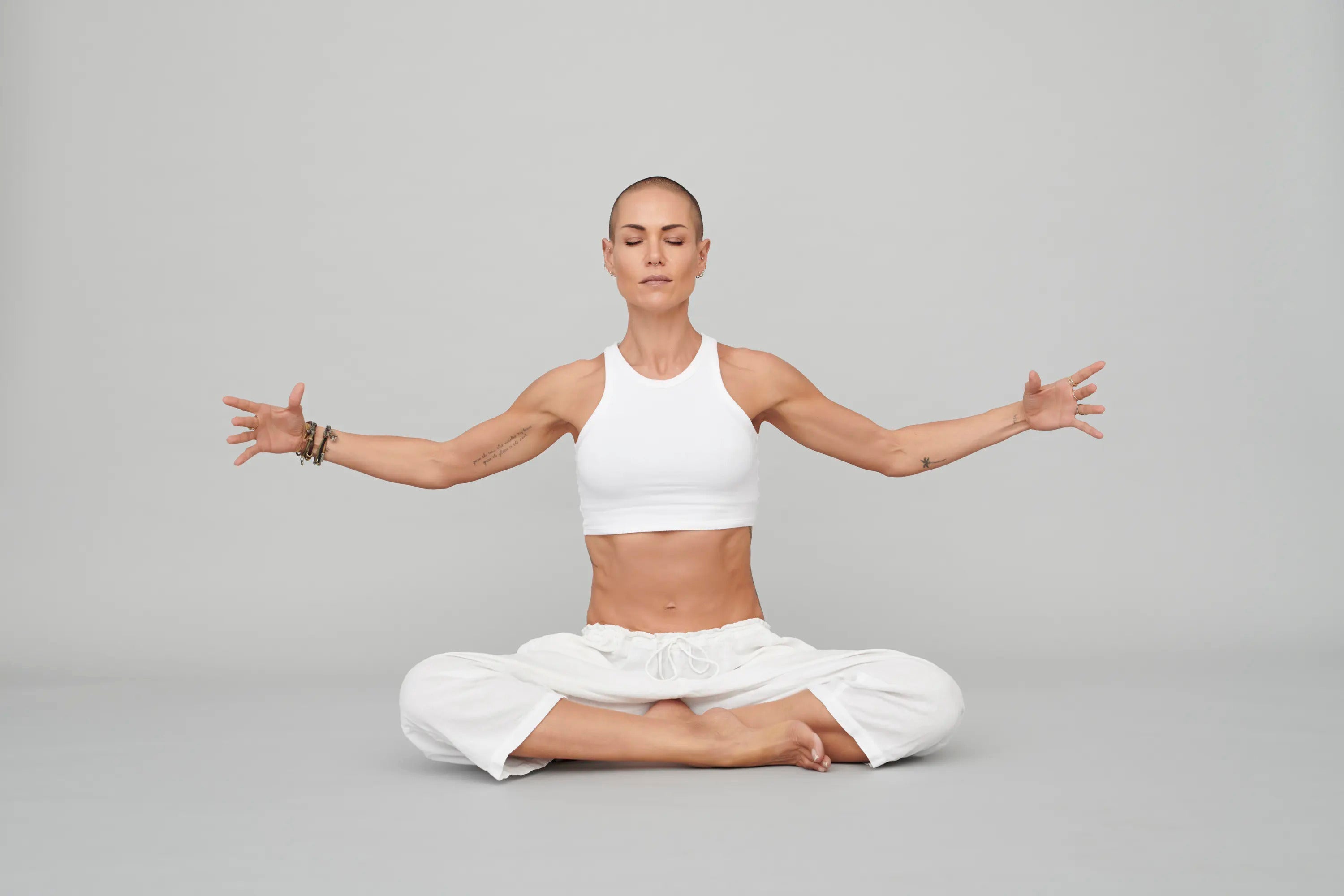
LEAH SIMMONS
'I was overtraining, starving myself, my relationships were falling apart, I was angry all the time, and my period stopped—all while the world saw me as the picture of health.'

Leah Simmons is a certified Pilates Instructor, Personal Trainer, and Kundalini Yoga Teacher. As a former record label executive and DJ, she was never one to blend into the crowd. After learning the hard way what wasn't working in her own health journey, Leah built KAAIAA in 2021, where her honest and raw approach to women's health goes beyond training the physical body and extends into spiritual, emotional, and mental wellbeing.
Where do you think your desire to help women comes from?
I'll be completely honest. The desire to help others came from needing to help myself first. I was in a place I wasn't enjoying, and the way I've always dealt with that is by experimenting and testing different things to see what works. Through that process, I landed on a few modalities that helped me not only physically, but emotionally and mentally as well.
When I saw the results, I thought that if this could help me, and I'm not unique or different from other women, then it might help others too. I put it out there, and it did work, and it still does. It became almost like an addiction, in the best possible way, and a real obsession, because I could see so many women struggling with symptoms that were being glossed over by countless medical professionals. Creating a community where we could talk about what we were never allowed to talk about, and take back control of our health, has become a self-fulfilling prophecy, and now I honestly can't stop.
How did you navigate moments of redefining who you were through these enormous professional and personal changes?
I wouldn't, by any stretch of the imagination, say it was a smooth ride. Don't believe everything you see from the outside. Music was my first love. I was very musical at school, I was a singer, I played the piano, and I played various instruments. When I left school, I wanted to pursue music, and at the time I think I was one of only two female DJs in Sydney, Australia. I didn't want to further study, I wanted to be experiential and get straight into it, so I went down that path.
Things moved quickly. I toured Europe, worked in the industry, and eventually found myself running a large independent record label. That was my life for about five years. I had a band, I was the lead singer, and I played at Glastonbury. At that time, fitness and wellness weren't even part of the conversation, wellness wasn't even a word. But as I was approaching thirty, it started to feel like Groundhog Day, with the partying, the nightclubs, and just going through the motions.
Around the same time, iTunes launched and almost overnight the independent record label industry collapsed. Distribution companies went bankrupt, labels went under, and that felt like a very clear sign. I've never defined myself by what I do or by a title, and I still don't. I believe we're here to experience everything life has to offer, but it takes confidence, discipline, commitment, and resilience. Those are things you learn over time.

From the outside, those transitions can look seamless, but how challenging was the process really, and what helped you move through it when things felt difficult?
It was very bumpy, and much harder than it looked. There were long periods of feeling like I was moving forward, then slipping backwards again. When that whole world ended, it wasn't just a career shift, it was the end of a lifestyle. The late nights, the touring, and the constant partying had been my normal, and stepping away from that took time.
When I moved back to Australia, my mum would take me to her Pilates classes whenever I came home because I looked exhausted. It completely changed my physique and posture, and I fell in love with it. I remember thinking, I want to pivot from being a night-time animal to a day-time animal.
So I went down the road of fitness. I did my studio certification and my PT qualification, which was about twenty years ago now, and I've worked in various studios since. As social media started to become more prevalent, I was one of the early people sharing workouts online. But, to be honest with you, that was actually the beginning of my downfall into a very dark place with my relationship with wellness.
How do you explain finding yourself in this state?
To be honest, it became about trying to maintain this perfect image. Getting the perfect shot, portraying a flawless lifestyle, like everything was under control. Meanwhile, there were hundreds of photos in my camera roll I wasn't happy with, and the plate of food I'd just photographed as my day on a plate would end up in the bin.
The pressure to have this ideal physique while making it look effortless really took its toll. I was saying I was doing certain things, but I wasn't—I was actually doing the opposite. I didn't realise at the time how influential social media was, or that people on the other side of the screen were taking what I said as gospel.
I reached a point of complete cognitive dissonance. I was overtraining, starving myself, my relationships were falling apart, I was angry all the time, and my period stopped—all while the world saw me as the picture of health.
What shifted for you at that point, and how did your understanding of health begin to change?
By that stage, I had a small child, my son, and I could see the toll it was taking on my life and on my relationships. I wasn't with his father anymore, and even my relationship with my son was starting to suffer because I was so absorbed in keeping up appearances. Around that time, I met my now ex-husband, who lived in Bali, and spending time there was the best thing that could have happened to me. I was introduced to different modalities and methods that helped me realise that true health is so much more than just your physicality.
It made me question everything. If you can train your body, how do you train your mental health? How do you look after your emotional health when it is so intrinsically linked to everything else? That was when I really understood that you cannot perform at your peak in one area while ignoring the others. Real health has many pillars, even if you cannot see them.
I used to make spaghetti bolognese for my kids and hide all the vegetables in it so they would never know they were there. And I thought, how do I hide all of these modalities into a workout so people do not know they are doing it, but they are doing it? With my music background, I was always remixing things, so I thought I would remix the best parts of everything that had worked for me into something people could do every day.

Do you think your personality, your capacity to feel deeply and be passionate, helped you move out of that dark period?
One powerful thing I learned is that intention without action leads nowhere, which is why I am not a fan of positive affirmations on their own. You can say all the right things, but unless you combine them with action and consistency, nothing changes. The only sentence that truly helped me was, I am responsible for my own change. If I wanted change, I had to make it happen.
I remember looking at my children and thinking, if something does not change, this is going to end badly. No one was coming to save me, I had to save myself. The hardest mountain to climb was right at the beginning, taking that first step and accepting responsibility for where I was.
I focused on one small, achievable thing each day and built from there. I do not chase perfection, I chase progress. And if my words can help another woman take action for herself, then that is what matters.
Was there a moment when you realised you had to let go of the body you had been obsessed with in order to move forward?
The feeling on the inside started to override what was happening on the outside. The body looked the way it looked, but it felt awful. My energy levels were in the toilet, I was sore all the time, and it was no longer a functional body. I could not recover properly, it was letting me down, and it just became too much.
What is funny is that now, at 48, I look, feel, lift heavier, and function better than I did at 38, when I thought my body was physical perfection. We have such a skewed view of ourselves and obsess far more than anyone else ever does. At some point, you have to make a choice, trust the process, go back to the science, manage stress, and prioritise recovery and sleep. I know genetics plays a part, but there has also been a lot of hard work and sacrifices. I have let go of things that no longer serve me, and that choice allows me to show up every day and do what I want to do, in the way I want to do it.

You have mentioned the four pillars before. Can you explain a bit more deeply what KAAIAA is and how it came together?
KAAIAA was really a way for me to combine all of the things I was already doing into one efficient solution for people who do not live in Bali and do not have all the time in the world to explore all of those different practices. Because of my music background, I was very adamant that there had to be a strong musical element, so I created a soundtrack that sits behind the workout. It is a sonic immersion and a journey that you move through via the four components of the practice.
When I moved back from Bali and launched it in Australia, I had no idea how it would be received. From the very first class, I knew I was onto something. I made my sister cry, and she does not cry at anything. She was the biggest sceptic around all of that sort of thing, and she sat in the class with tears streaming down her face. That was the moment I knew it had worked.
How did KAAIAA grow from a small studio into the wider offering it is today?
I had a small community space in Bondi that was really busy and going well. There was a lot of momentum. In May 2021, we went into lockdown and I had to close the studio. I told my clients I would run a free class every morning on Zoom to keep the momentum going. I thought it would last two weeks, but it went for three months, and I taught 78 days straight online.
By August, I was getting around 700 people a day joining from all over the world. It became this amazing place for people to come together. I would always start the class dancing to some horrendously daggy eighties song, just to make everyone laugh and feel comfortable. After lockdown, I did not return to a physical space. KAAIAA became one part of a much bigger experience, built around movement, strength, recovery, mindset and nutrition, created for women who do not want to be taught by a twenty-year-old guy who does not know how to talk to them, let alone train them. They want a space where they feel like they are the main character.
What is it about perimenopause that feels so scary to people?
I do not actually think it is scary. I think it feels scary because it is so unknown. For a long time, so many symptoms were misdiagnosed or not diagnosed at all. Even until quite recently, GPs were often treating the symptoms rather than the root cause. If you were depressed, you were given antidepressants. If you could not sleep, you were given sleeping pills. Menopause was medicalised without addressing the actual hormone deficiency behind it.
There is also a huge misunderstanding around how menopause is defined. Women can suffer symptoms for years, sometimes five or ten, before they officially reach menopause, yet they are told it does not count until they have missed a period for a full year. Thankfully, that is starting to change. More research, more conversation around hormone replacement therapy, and more women in medicine are making a difference. I do not think this is a passing moment.
Personally, I had a partial hysterectomy last year because of a massive fibroid and a polyp. The fibroid was so big that the advice was it would be harder to remove it than to take the whole uterus. I was not attached to my uterus emotionally, but my main question was, do I get to keep my ovaries? What are the implications of this? Is it going to push me into menopause? Luckily, I was able to keep my ovaries, which meant I still ovulate and experience PMS symptoms, even without a uterus, cervix, or periods.

Why do women come to you, and what do they usually want to achieve?
What really comes out during consultations is that most of them feel lost. They've lost their identity, they feel unseen and unsexy. They want to feel like themselves again and be in a space where they can express how they really feel. What they like about this program is that it's tailored to them, and there's no stupid question. Everyone has something, whether it's a frozen shoulder, hip replacement, or ankle issue, and they feel safe knowing that.
It's funny because they'll come in saying things like, 'I want to lose X kilos. I want to do this, I want to do that.' But after a week or two, they rarely talk about that again. What matters to them is how they feel. Later, they'll come in and say, 'Oh my God, this pair of jeans I haven't worn in five years fits me.' The focus shifts from numbers to feeling stronger, standing taller, and gaining confidence.
How important is community in your program, and why?
Everything. Everything. It is everything. Research now shows the effects of loneliness can be as bad as smoking, and it's become an epidemic, especially as women live longer than men and are more likely to end up alone. Community is crucial for staying independent, strong, and able to walk to a friend’s place or enjoy activities together.
I'm not training them just for tomorrow. I'm training them for 20 years from now. The goal is to keep them mobile, self-sufficient, and able to enjoy life. I want to close the gap between lifespan and healthspan and make that decline less steep, so they can have as much quality of life as possible for as long as possible.
How do you approach recovery in your programs, and what are the most important aspects?
Our program is built around four weekly sessions: two strength sessions, one KAAIAA class for mindset, and one mobility class. Recovery is fully integrated, with time built into the sessions, and we encourage additional practices like saunas, steam, ice baths, or infrared treatments at a nearby recovery centre. In the studio, we have an infrared roller massager named George Clooney, which helps with lymphatic drainage and overall recovery.
Recovery is not optional. Most of the women we work with have some form of osteopenia or osteoporosis, so protecting joints, strengthening bones, and supporting the body from the inside out is essential.

Why is it important to let go of past versions of ourselves, and what does that mean to you?
I don't think I've let go of any past version of myself. I've just been able to let in a new version. I'm the same fundamental human, but I've gained more patience, wisdom, and the ability to prioritise emotional things to navigate desired outcomes. I've learned to stop people-pleasing, found balance around my drive, and committed fully to the things that matter, whether it's my clients, my staff, or my family.
Past versions of me still exist and sometimes show up, but they've all contributed to who I am today. I embrace all aspects of myself—there's no single version. Some behaviours I no longer repeat, but at the core, I'm stable and grounded in who I am while allowing room for growth and evolution.
What are your wildest dreams for the future?
I'd love to see KAAIAA scale, open more studios, and take it overseas. Alongside that, I want to bring it into communities that need it most—marginalised communities, indigenous communities, and regional areas. There's a real need for women's health support in terms of longevity, safety, confidence, and empowerment, and I want to make a difference there.
I'm passionate about helping women take back control of their health and showing them that this isn't the beginning of the end. It's the beginning of something entirely new.
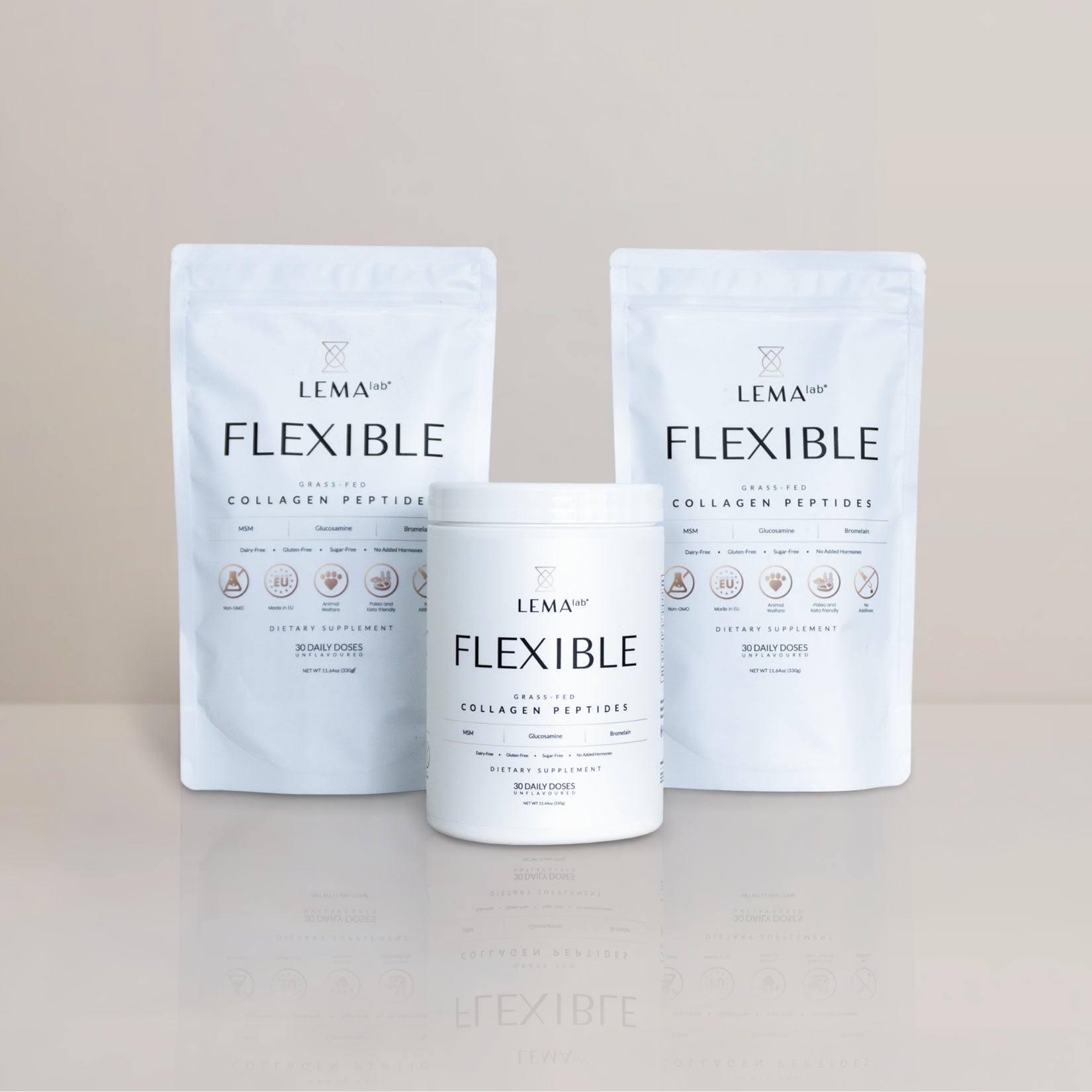
*This interview was originally featured on the Flexi Podcast, the LEMAlab® podcast hosted by Erika Lemay. The full episode is available on Spotify and YouTube.





Leave a comment
This site is protected by hCaptcha and the hCaptcha Privacy Policy and Terms of Service apply.